
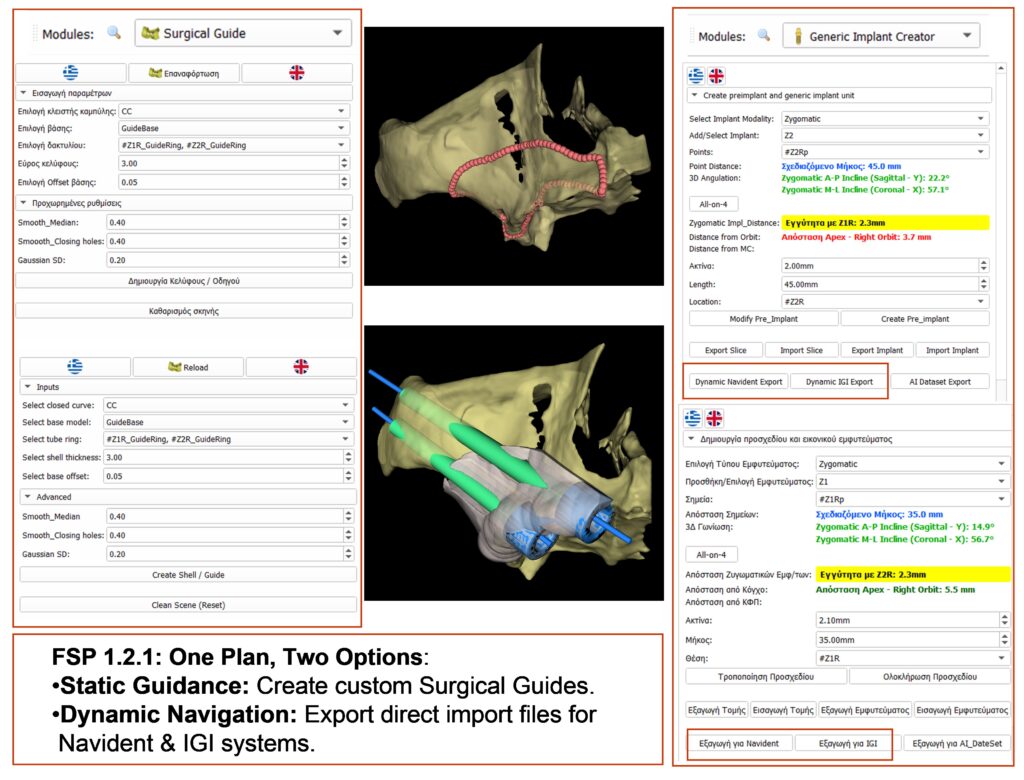
Η βασική ιδέα πίσω από την ανάπτυξη της έκδοσης 1.2.1 ήταν να δοθεί η δυνατότητα σε έναν έμπειρο γναθοπροσωπικό χειρουργό ή οδοντίατρο να εκτελεί τον τρισδιάστατο προεγχειρητικό σχεδιασμό (pre-planning) μία μόνο φορά και μέσα σε ένα περιβάλλον ελεύθερου λογισμικού και στη συνέχεια, με το πάτημα ενός κουμπιού, να επιλέγει τη μέθοδο μεταφοράς του ψηφιακού πλάνου στο πραγματικό χειρουργικό πεδίο.
Στην έκδοση Slicer FSP 1.2.1 (https://freesurgplan.edu.gr/) αυτή η κλινική ιδέα υλοποιείται μέσω δύο αυτόνομων ροών εργασίας (Hybrid Workflows):
- Επιλογή Στατικής Καθοδήγησης (Static Guidance): Ενεργοποιείται το module ‘Surgical Guide’, το οποίο επεξεργάζεται την βάση στήριξης και τους δακτύλιους καθοδήγησης παράγοντας το τελικό 3D αρχείο (STL) του χειρουργικού οδηγού έτοιμο για τρισδιάστατη εκτύπωση (3D Printing).
- Επιλογή Δυναμικής Πλοήγησης (Dynamic Navigation): Μέσα από το αναβαθμισμένο module ‘Generic Implant Creator’ εξάγονται τα απαραίτητα open-platform ψηφιακά αρχεία σχεδιασμού για τα συστήματα Navident (αρχεία .csv με Entry/Target LPS vectors) ή IGI DenX (αρχεία .txt με Direction Cosines). Τα αρχεία αυτά εισάγονται απευθείας (Direct Import) στο λογισμικό της αντίστοιχης συσκευής χωρίς ανάγκη χειροκίνητης πληκτρολόγησης.
Συμπερασματικά:
Η πλατφόρμα του Slicer FSP 1.2.1 εισάγει μια ολοκληρωμένη διπλή ροή εργασίας (Hybrid Workflow), η οποία βασιζόμενη στην vector-based αρχιτεκτονική του ιατρικού προτύπου LPS (Left-Posterior-Superior) εξασφαλίζει sub-millimeter ακρίβεια μεταφοράς δεδομένων ενώ παράλληλα θέτει τις τεχνικές βάσεις για τη μελλοντική απευθείας διασύνδεση με open-platform συστήματα Ρομποτικής (Robotic Implantology).
The core concept behind the 1.2.1 release is to empower experienced maxillofacial surgeons and dentists to perform their 3D pre-operative planning just once within an open-source software environment and then at the click of a button choose the exact modality for transferring that digital plan into the live surgical field.
In Slicer FSP 1.2.1 (https://freesurgplan.edu.gr/) this clinical concept is implemented through two distinct workflows:
- Static Guidance Option: Utilizes the ‘Surgical Guide’ module to process the guide base and the guide sleeves automatically generating the final STL mesh of the surgical guide optimized for 3D printing.
- Dynamic Navigation Option: Directly from the upgraded ‘Generic Implant Creator’ module, clinicians can instantaneously export open-platform planning data tailored for Navident (.csv format utilizing Entry/Target LPS vectors) or IGI DenX (.txt format incorporating normalized Direction Cosines). These native files are ready for direct, automated import into the respective clinical navigation hardware bypassing manual data entry.
Conclusion:
The Slicer FSP 1.2.1 platform introduces a comprehensive dual-modality ecosystem (Hybrid Workflow). By leveraging a unified vector architecture mapped to the standard medical LPS (Left-Posterior-Superior) coordinate system it guarantees sub-millimeter data fidelity across devices while firmly establishing the algorithmic foundation for future compatibility with open-platform Robotic Implantology systems.
Leave a Reply